Showing posts with label open questioning. Show all posts

Friday, 14 August 2015

Problem solving connects to the world outside the classroom

So there’s a thing called productive pedagogies and it forms part of the quality teaching framework. Each one is important, but my favourite is under significance connectedness to the world

I still remember my high school days (although many years ago now), and sitting in maths wondering how I would ever use the stuff I was learning. I can honestly say that I have even used functions such as Cos, Tan and Sin in the real world. I would really have liked my teachers to show me the connectedness of what I was learning with contexts outside the classroom – maths would have been far more interesting!

So in this resource, Ask a Mathematician, problem solving has been put into a context in which learning could be applied in future careers. Not that all your students have career aspirations to be wildlife keepers at Wally’s Wildlife Park like Josie and Jack in the activity, but it does pose a real-life problem. Let’s hope when your students finish school and go to work that they don’t have a trickster boss like Wally!

And of course, it's a Project Nature-Ed resource, so there's nature mixed in with mainstream curriculum.


Some things about the critters in the problems that you will need to know:
  • the sea stars referred to in this activity have five arms, and on the end of each arm is an eye (pretty cool!)
  • snails have two eyes, one on each antennae, but not tail because they slide along on a big muscular foot
  • sea snakes have no fins but do have a paddle-like tail to move along in water
  • fish have two eyes, two fins and one tail (at least that one was easy)!


Friday, 17 July 2015

Reflecting on thinking and processes

What? Another proforma asking students to reflect on their learning? Convenient … yes, but is there any real thinking involved? Depends what you do with it and the reasons for giving it!

If you hand out the surveys, get them back and don’t do anything with it, then what was the point, but if you use the information for something, then absolutely ... there is a purposeful use.

A survey is just one tool in a teaching toolbox, you can follow up what you find with one-on-one questioning with individual students, particularly if a student believes they understand content, but their work displays a conflicting outcome. A survey is just one of the tools in your toolbox, but can give you some useful results.

I first used this survey during a Science and Technology unit of work that I was delivering to a multi-stage (Year 3-6) class because I wanted them to be active participants in their learning and also evaluate if whether what I, as the teacher, was delivering was interesting to them. There was also gifted and talented students in this class as well a wide disparity between literacy skills due to the multi-stage scenario. It was a real juggling act within the group setting to extend some students and not lose others with content that was too in-depth and intricate for their level of understanding. Were they still with me? Was I boring them to tears? This is what I wanted them to tell me!

Get your free copy of my survey tool here!

As a straight statistical analysis of the data, I plugged it into a spreadsheet and out came my results visually!
Survey responses received from my students.

Although the survey was anonymous, often you can tell by the handwriting who owns it, and I pulled some of the kids aside for a one-on-one oral reflection. During this reflection, I wanted to get them to justify the thinking behind the choices they made so I asked them questions about their answers.
Asking open ended questions aids critical thinking.

If this reflection tool was a straight tick a box survey, I don’t think it would achieve much, but because it also contains an open ended question, students have the opportunity to tell a teacher about what they learnt.

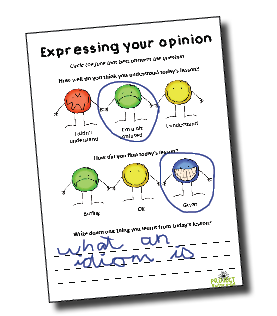
For example, I used this survey during a unit on poetry for Year 5. After looking at a range of idioms, the task was to include an idiom in the poetry piece they were working on. What this returned survey told me was that this student:  
  • enjoyed how the content was presented and their task (my teaching was good!) 
  • believed they knew what an idiom was 
  • was confused about how to include an idiom in their poetry task (if you know who the student is you can target this area, or if it was a common response, this provides you with a target for future lessons).
A returned student survey.
Responses on surveys aren’t everything as students could be replying based on what they think you want them to say, but as a tool in teaching students to learn to become critical thinkers, they are helpful.