Showing posts with label nature. Show all posts

Friday, 14 August 2015

Problem solving connects to the world outside the classroom

So there’s a thing called productive pedagogies and it forms part of the quality teaching framework. Each one is important, but my favourite is under significance connectedness to the world

I still remember my high school days (although many years ago now), and sitting in maths wondering how I would ever use the stuff I was learning. I can honestly say that I have even used functions such as Cos, Tan and Sin in the real world. I would really have liked my teachers to show me the connectedness of what I was learning with contexts outside the classroom – maths would have been far more interesting!

So in this resource, Ask a Mathematician, problem solving has been put into a context in which learning could be applied in future careers. Not that all your students have career aspirations to be wildlife keepers at Wally’s Wildlife Park like Josie and Jack in the activity, but it does pose a real-life problem. Let’s hope when your students finish school and go to work that they don’t have a trickster boss like Wally!

And of course, it's a Project Nature-Ed resource, so there's nature mixed in with mainstream curriculum.


Some things about the critters in the problems that you will need to know:
  • the sea stars referred to in this activity have five arms, and on the end of each arm is an eye (pretty cool!)
  • snails have two eyes, one on each antennae, but not tail because they slide along on a big muscular foot
  • sea snakes have no fins but do have a paddle-like tail to move along in water
  • fish have two eyes, two fins and one tail (at least that one was easy)!


Saturday, 18 July 2015

Going on a froggie webquest

Ever run a webquest in your class?

I created a really short one as a bonus with a set of my free Buzz Brains cards. The webquest topic became relevant to the activity because I put frogs on the back of all the activity task cards. I’m all about mixing nature up with mainstream curriculum so why not include frogs in maths!

There are a number of ideas for including the webquest in your classroom in the activity description for the Buzz Brains cards, but here's another way to use it.

Unless students are explicitly taught how to search for information on the internet, they end up overloaded with FACTS, much of which needs to be filtered to get to what they really need. I’ve used simple webquests like this to teach about internet searching.

If a student plugged the three clues on the webquest into a search engine, they would find the answer, but to explicitly teach, I have demonstrated as a whole class about how to narrow down information.

First, let’s search for frogs (the first clue) .. about 150,000,000 hits. Far too many!


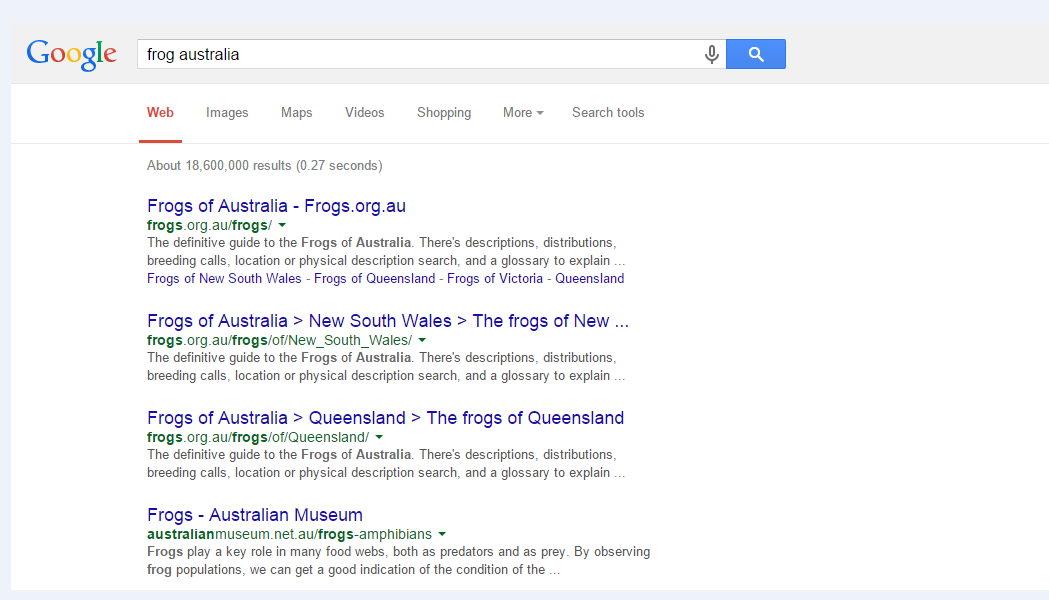
Next, let’s refine it a bit and only search for frogs in Australia (the second clue) … about 18,600,000. Still too many to sift through!


Let’s now include the third clue caerulea and … only about 58,400 results, but bingo … a quick scroll down will show that all hits are about Green Tree Frogs, the answer.


Happy webquesting.

Friday, 10 July 2015

The Insect Files: THE LADYBUG EDITION

Friends of 10 addition

With this Friends of 10 activity, you want to get your students using a range of mental strategies to build number relationships and understand that addition is the joining of two groups.

Get the activity here.

Quick recall of basic facts makes maths easier as it gets more complex. I've seen so many kids in the later years of primary school anguish over maths, not because they aren't good at it, but because their quick recall of number relationships isn't there.

A deck of playing cards and some whiteboard markers and you’re ready to go.

How to run this activity

Lots of options:
- at a maths rotation station
- as an independent activity
- use cards to guide whole group instruction.

Explicitly explain the task

Lots of ways to do this, but one way I have done this is during a whole class session by running a mini-lesson. Pick a random number from 1-9 and get that number of kids up the front of the classroom. Visually the students can see this, so they can then figure out the other number required to make ten.

Two groups of students helps make sense of grouping of numbers to make 10.
For fun, make your explanation a case study. For example, put it to your students like this:
Your parents said you can have 10 friends over for your birthday party. You have already given out 6 invitations to your friends. [Get six kids up]. How many more invitations can you give out? [Continue to get more kids up as your students count on, stopping at 10].
Write 6 and 4 on the whiteboard and say the numbers are “Friends of 10”. Then explain the activity using the cards. 

Students draw a card and then ask group members for its friend.

And now … the NATURE stuff!!!!

I have included different Ladybug facts on each of the five cards because I really want this activity to generate conversation about topics beyond straight maths (and not just keep the natural world in science)! Here are some ways you might be able to connect this activity with the natural world outside of the classroom.

If counters are needed to play this game, make ladybugs counters from bottle tops
Use a permanent marker for the spots and shading and stick on some googly eyes. Very cute!
Create a word wall or mind map. Use the facts as a literacy activity to build knowledge around a central theme, e.g. insects, gardening (ladybugs are beneficial insects), etc. You can even start to show ecological relationships.
sun → provides energy → plants can grow in your garden → attracts ladybirds → eat aphids which destroy your garden → food for you to eat 
Mind mapping helps students see connections.

After another way to use the activity?

Activity could be run as a whole class activity by displaying a resource card on an interactive whiteboard. Teacher chooses a number from a deck of cards and asks students to give the other number to make “Friends of 10”.

Use your imagination! Use this activity during whole class teaching.

Differentiation within the activity

  • Provide concrete materials such as counters or number lines to help your students figure out the missing numbers. Some students may already be counting on from the biggest number and won’t need these, but others will.
  • To extend students, get them to use small whiteboards and write out the groupings that make Friends of 10 in equation format.
Extend students by writing facts as equations.

Blog clipart - thanks to A Sketchy GuyHappy Little Daydreams, Graphics from the Pond.